

HEART is not a framework.
It is a leadership operating system.
in the AI era, what breaks first is rarely strategy. It's people.
HEART is designed to close the gap between what acceleration demands
and what human organizations can actually sustain.
HEART was built from 13 years inside startups and high-growth companies
— not from the outside looking in.
The real problem
Most organizations invest in strategy. Very few invest in the system that makes it work.
What breaks first
Not tools. Not processes. People. Leadership. Trust.
What HEART does
Identifies exactly where — and builds the infrastructure to fix it.
One interdependent system.
Remove any element and
the chain breaks.
Click each element to explore what it means and why it matters.
Most organizations see outputs. They don't see hesitation, silent resistance, overload or disengagement — until it shows in results.
If you don't see it, you can't lead it.
Empathy is not softness. Under pressure, it is a decision-making capability — understanding what blocks adaptation before it slows execution.
Without this, execution slows silently.
Misalignment is one of the largest hidden costs in any organization. Different priorities, shifting expectations — noise that kills momentum.
Alignment is what turns strategy into movement.
Most organizations either avoid responsibility or assign blame. Neither drives performance. Real ownership means people execute — not protect themselves.
Without this, people protect themselves instead of performing.
Trust is not a culture metric. It directly impacts speed, decisions, collaboration and retention. When trust drops, performance drops — always.
Trust is not a feeling. It's a performance driver.
Five factors. One chain.
These are not five separate workstreams or initiatives. They are one interdependent system — and the sequence matters.
In the AI era, leadership is not a title. It's a capability. It happens at every level — from the CEO making strategic calls to the individual contributor deciding how to use an AI tool.
HEART is designed to build that capability systematically — across the entire organization, not just the leadership team.
H —Human Performance Visibility
f you don't see it, you can't lead it.
Most organizations see outputs. They don't see what's happening underneath — the hesitation, the silent resistance, the overload, the quiet disengagement. By the time those things show up in results, the damage is already done.
H is about making human performance visible before it becomes a crisis. Identifying where performance is already weakening. Understanding how people are actually experiencing change. Surfacing hidden friction early.
E — Empathy Under Pressure
Without this, execution slows silently.
Empathy is widely misunderstood as softness. In reality it is a decision-making capability — one that becomes critical when organizations are under pressure and moving fast.
Leaders who understand what their people fear, what motivates them and what is blocking adaptation don't just create better culture. They make better decisions and move faster. Without this, execution slows — silently, invisibly, and at exactly the wrong moment.
A — Alignment That Drives Execution
Alignment is what turns strategy into movement.
Misalignment is one of the largest hidden costs in any organization. Different leaders communicating different priorities. Expectations that shift without warning. Teams working hard in slightly different directions. In a fast-moving environment this doesn't just create friction —it makes AI acceleration actively dangerous, because you're moving faster toward the wrong outcome.
A is about eliminating that noise. Creating clear, consistent direction across the leadership team so thatstrategy doesn't just exist on a slide — it actually moves.
R — Responsibility Without Blame
Without this, people protect themselves instead of performing.
Most organizations sit at one of two extremes — either responsibility is avoided entirely, or it collapses into blame when something goes wrong. Neither drives performance. Both destroy trust.
R is about building genuine ownership at a system level. Defining clearly who owns what. Creating environments where mistakes lead to learning rather than self-protection. Shifting from individual blame to collective accountability.
When people spend energy protecting themselves, they have less energy for performing. That is a direct performance cost.
T — Trust as Economic Capital
Trust is not a feeling. It's a performance driver.
Trust is almost always treated as a culture topic — something nice to have, hard to measure, important but not urgent. That framing is wrong. Trust directly impacts the speed of decisions, the quality of collaboration, the willingness to take action under uncertainty and the ability to retain key people.
When trust drops in a leadership team or organization, performance drops with it. Always. T is about measuring trust signals, identifying where trust is breaking down and building the consistency between words and actions that makes trust durable.
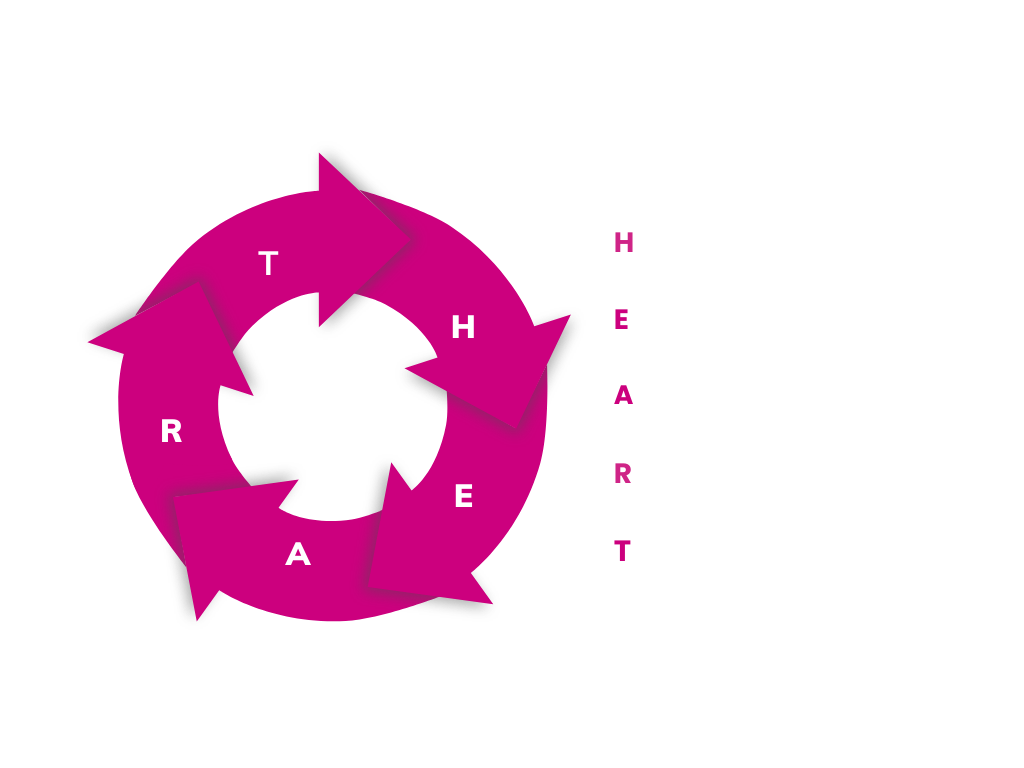
These are not five separate initiatives.
They are one interdependent system.
Remove any element and the chain breaks.
Without visibility, empathy is guesswork.
Without empathy, alignment doesn't land.
Without alignment, responsibility breaks down.
Without responsibility, trust erodes.
Without trust, performance collapses.
Click any link to see what breaks
We have built a proprietary diagnostic system that makes the five factors visible as data
— so leadership decisions are based on signals, not assumptions.
HEART is designed to be measured.
AI increases speed, complexity and expectations. It does not increase human capacity, emotional readiness or leadership clarity.
That gap, between what acceleration demands and what organizations can actually sustain, is where most transformations quietly fail.
HEART is designed to close that gap. And turn it into competitive advantage.
Ready to find out where your leadership system is breaking?
Start with an Executive Diagnostic. We assess your organization across all five HEART factors and give you a clear picture of where performance is at risk and what to do about it.